Speak the way you can.
Be heard.
AphaSay listens to broken speech from aphasia and reads back the sentence the person was trying to say. Real time. In your own voice.
The Problem
After a stroke, the words don't come out right.
Aphasia damages the part of the brain that turns thoughts into language. The mind is still sharp. The thoughts are still there. The words just come out wrong, broken, or not at all.
A person with aphasia might say "fork" when they mean "spoon." They might say a non-word like "blurk" when they mean "phone." They might know exactly what they want but only manage three fragments before they give up.
Their family stops asking. Friends visit less. The person stops trying.
Live reconstruction
Features
Everything you need.
Nothing you don't.
Problem guides
Problems we help with.
Plain-language guides for speech, language, reading, writing, and everyday communication after stroke.
How It Works
Speak however you can.
We figure out the rest.
See it in action
Watch the overview.
A quick look at how AphaSay works — from opening the app to hearing your words spoken back in your own voice.
The App
Designed to be used
with one hand.
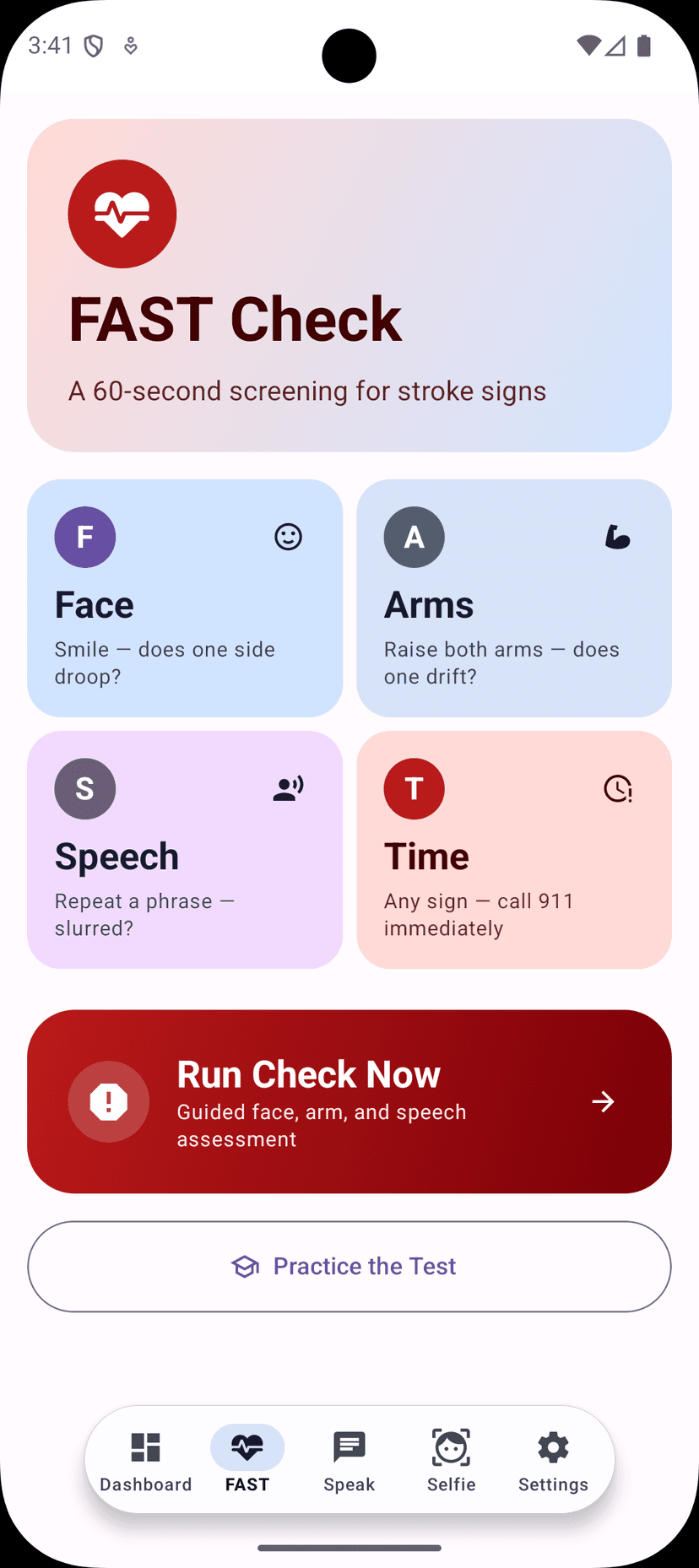
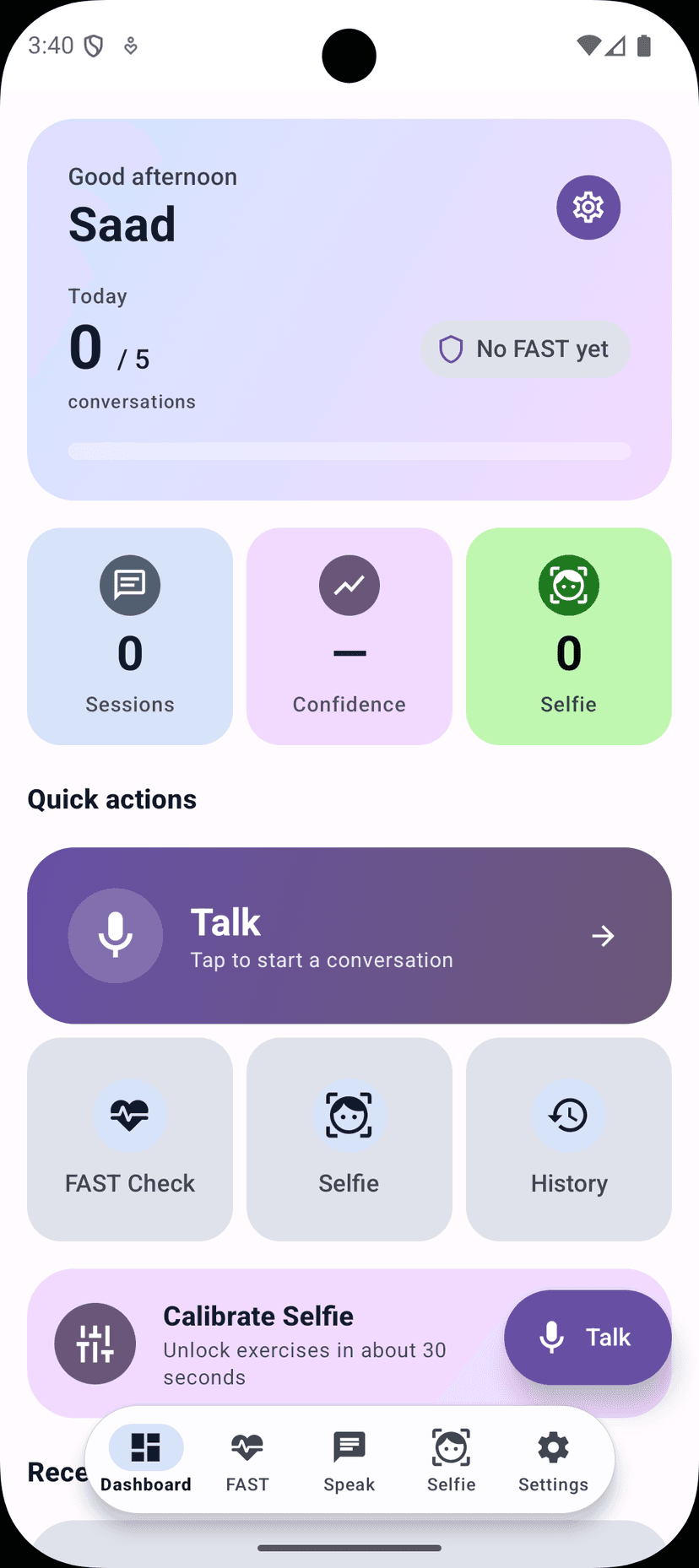
FAST Check — stroke triage
Dashboard — goals, stats, AI coach
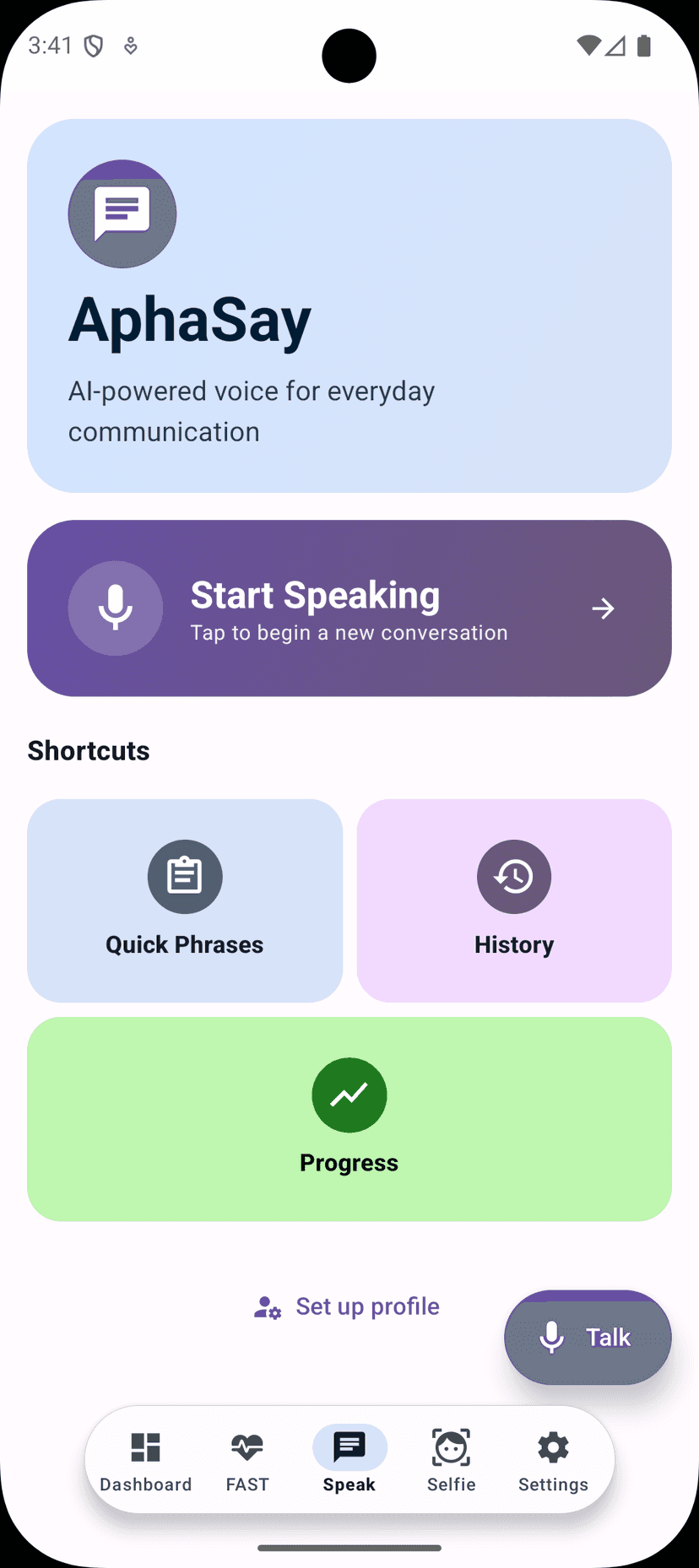
Speak — AI reconstructs your words
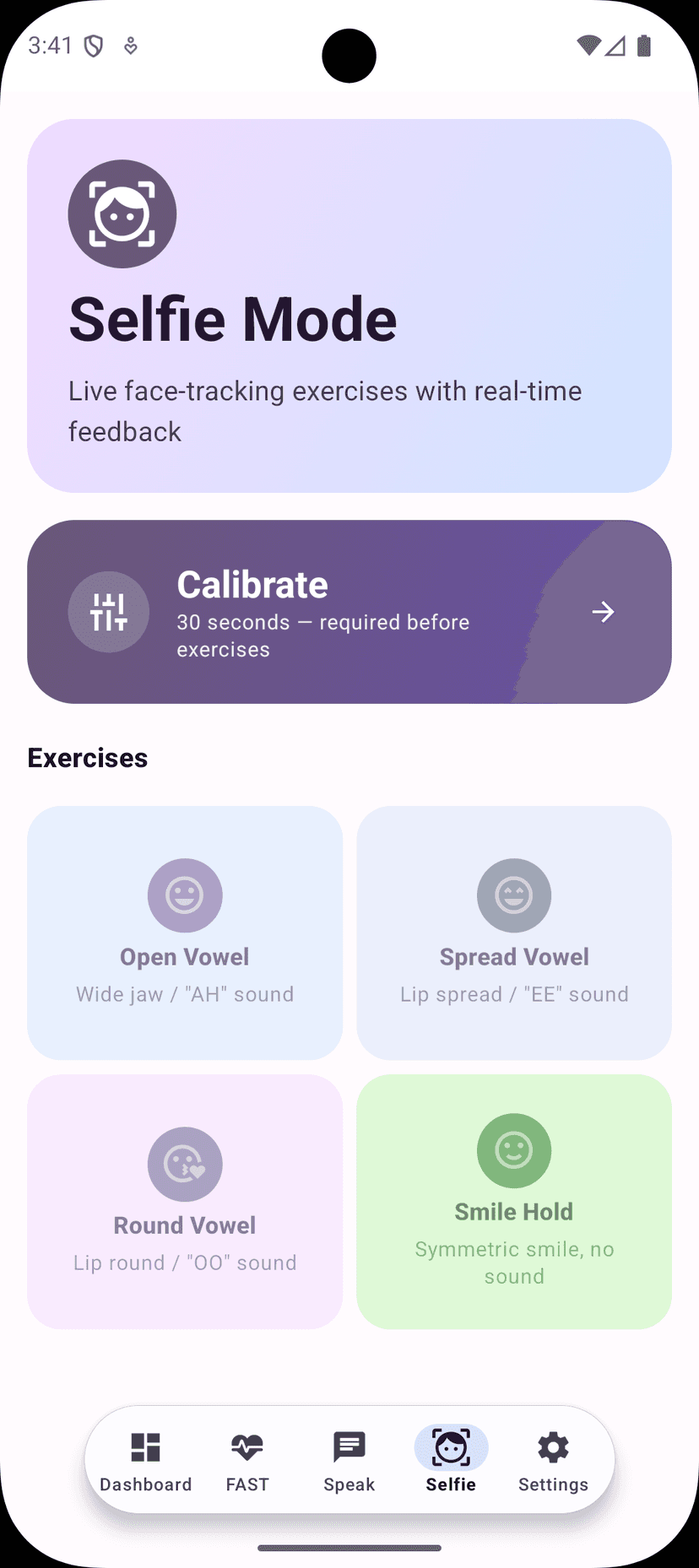
Selfie — live face-tracking exercises
Want to try it right now? Join the beta waitlist for instant access on Android today — iPhone coming soon.
Examples
What AphaSay actually
sounds like.
Patient said
"phone... wife... call... now"
AphaSay said
"Please call my wife on the phone now."
Patient said
"want blurk... cold... kitchen... thing"
AphaSay said
"I want something cold from the kitchen."
Patient said
"head... hurt... medicine... need"
AphaSay said
"My head hurts. I need my medicine."
Evidence Base
Built on clinical research.
Not guesswork.
AphaSay's exercise content, scoring methods, and feedback system are grounded in published speech-language pathology research.
Neuroplasticity & frequency
Neuroplastic recovery responds to practice frequency over intensity — supporting our daily short-session model over weekly marathon sessions.
Bhogal et al., Stroke, 2003
Motor speech feedback loops
Real-time visual and auditory feedback during speech exercises improves motor learning retention. AphaSay provides both — camera overlay and audio scoring — on every rep.
Maas et al., American Journal of Speech-Language Pathology, 2008
Facial rehabilitation & symmetry
Structured physical rehabilitation improves facial symmetry and function after facial palsy. AphaSay tracks symmetry automatically across every session.
Vaughan et al., Frontiers in Neurology, 2020
AI reconstruction of aphasic speech
La Trobe University's 2025 study showed GPT-4o correctly reconstructed 80% of aphasic utterances from AphasiaBank data — the research foundation for AphaSay's Talk mode.
Adikari et al., Scientific Reports 15:24725, 2025
Privacy
Your voice. Your data.
Nobody else's.
Audio is encrypted on your device and on our servers. Recordings are deleted on a schedule you control. We do not sell data. We do not show ads. We do not train AI models on your conversations.
Start speaking again.
Beta access is free and open now. Join in under 30 seconds.
Join the Beta — FreeMore from Stroke Technology
Other apps for stroke recovery and independence
Tools designed to make recovery more doable every day.